
The subject matter argument presented in this blog communication shares a real life hypothetical regarding how Corporate Machiavelli will pressure you as a disabled veteran to turn over information when a “corporate citizen” suspects you as an employee have a service-related PTSD.
Human Resources papers you through documentation, who will later use the information in Court to identify you as “combative” or “threatening” when you challenge the legality of the retrieval of VA medical record information, which happened to me.
As a client with the Wisconsin Division of Vocational Rehabilitation who entered the workforce for Marcus Corp. working at the Sun Prairie Marcus Palace Cinema and Live Nation d/b/a Frank Productions LLC at the Sylvee, the Majestic, Breese Stevens Field, High Noon Saloon and the Orpheum, both employers DID NOT follow proper VA Privacy Guide Protocol.
For my upcoming meeting with Marcus Corp.’s counsel, the Respondent’s counsel requires I turn over my secret security clearance and ALL information regarding my socials protected under discrimination argumentation by the Federal Labor Relations Act. The corporate citizen uses intimidation of an irrelevant subject matter to intimidate me into submission, which I will not do.
I am required to disclose information without my consent along with answer burdensome questions in the form of interrogatories that do not apply in this case. The Respondent’s counsel also requires I provide confidential communication by Tribolt Security LLC’s Chief Executive Officer Dave Marerro, a well-known and respected Special Forces operator. I have informed the Wisconsin Supreme Court Office of Lawyer Regulations regarding my perception of intimidation that resulted from the adherence to filling out both Respondents’ interactive dialogue process questionnaire seeking information beyond the scope of requested accommodations, which employers cannot do.
As an upstander and 10th Mountain Division QRF observer reporter in the community, I exposed the information publicly and now I must face the wrath on March 12, 2026, at my Wisconsin ERD appeal hearing facing off self-represented as a law student against Marcus.
The substantive fact in both cases comprises prima facie that the employers received multiple complaints and management did not escalate to Human Resources regarding multiple employees who threatened violence that eventually led to the termination of one who stated, “Don’t just die! Suffer!” The managers stated the dialog reported by multiple employees “did not rise to the occasion” to escalate. Yet, according to the information provided to me by Lt. Cindy Holmes of the Dane County Sheriff’s Dept., who declared most certainly did.
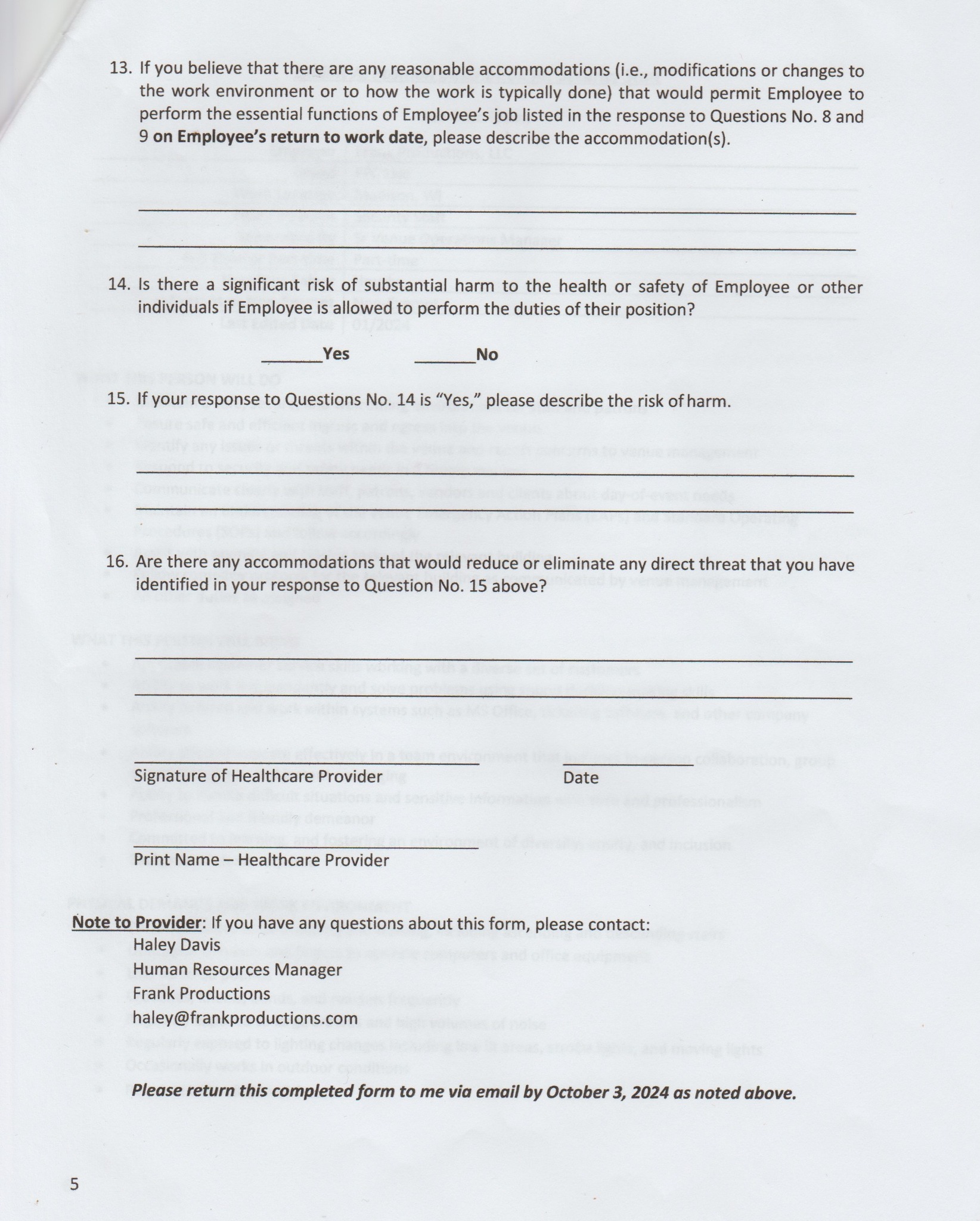
Frank Productions LLC terminated me after I declined to blindly follow the employer’s demands I fill out an interactive dialogue process questionnaire. The overreaching scope of both parties’ questionnaires exceeded the protocol of VA patient “self-reporting.” Frank Productions LLC, not being happy with the response by the VA’s primary care provider, made clear I needed to go to “real” primary care provider to clear me as a perceived threat. No civilian primary care provider can access your VA records without your permission and this royally pissed the Human Resources manager off as I reported here in previous DVR discrimination blog press release reports as outlined in my college indpendent study.
Frank Productions LLC, the author of the document currently submitted to an ERD investigator as an exhibit, models a similar attempt to legally retrieve information from the VA suspecting I was a disabled veteran with PTSD for making clear I must first speak with my VA primary care doctor, the VA Privacy Director, EEOC Senior Legal Analyst Sharron Rennert and the DVR director before sharing information that could expose what I did while serving as a Special Forces commander’s RTO in Haiti while serving on QRF.
The companies dug deep and because I resisted, I was a perceived threat for standing up for VA patient medical record privacy that I perceived as discrimination. For the sake of protecting fellow deployment vets, I shared my DVR progress report observations publicly to warn other veterans, which is my legally protected right to do here at Outpost 422.
I later self-reported through my VA primary care provider I have “LightFighter Syndrome (migraines),” which was an amendment I field with my VA record privacy to discuss publicly my time down range regarding my traumatic brain injury. I was informed I did not need to disclose any condition other than what I was requesting accommodations for yet the employers made ironclad either I fill out the forms or risk losing merit and had Frank Productions LLC CEO Joel Plant make clear would not accommodate me unless the form featured below was filled out. For this reason, I have rebranded Outpost 422 as a VA Patient Adjudicator service to inform those who are afflicted by a bad-faith employer who uses interrogatories and Human Resources demands to intimidate you into availing a PTSD diagnosis for papering purposes.
The service is registered with the VA Inspector General Office to connect you as a VA patient with information regarding how to connect with free VA pro bono legal services to help you navigate.
Concerted Activity: The Federal Labor Relations Act
You have the right to act with co-workers to address work-related issues in many ways. Examples include: talking with one or more co-workers about your wages and benefits or other working conditions, circulating a petition asking for better hours, participating in a concerted refusal to work in unsafe conditions, openly talking about your pay and benefits, and joining with co-workers to talk directly to your employer, to a government agency, or to the media about problems in your workplace. Your employer cannot discharge, discipline, or threaten you for, or coercively question you about, this “protected concerted” activity. A single employee may also engage in protected concerted activity if he or she is acting on the authority of other employees, bringing group complaints to the employer’s attention, trying to induce group action, or seeking to prepare for group action. However, you can lose protection by saying or doing something egregiously offensive or knowingly and maliciously false, or by publicly disparaging your employer’s products or services without relating your complaints to any labor controversy.
Denying an employee/former employee’s right to uphold Wis. Stats. 103.20, specifically “Hours of Operation,” I reported my concerns to the director of DVR in the form of blogs and social media posts fully protected under my civil rights under said Act. After filing an ERD complaint, retaliation for speaking publicly began by Attn. Welsh in the form of interrogatory who willingly acted above the language contained in DWD 218, while I self-represented through the Outpost 422 whistleblowing agency.
The Federal Labor Relations Act Section 1.[§151.] states, “The denial by some employers of the right of employees to organize and the refusal by some employers to accept the procedure of collective bargaining lead to strikes and other forms of industrial strife or unrest, which have the intent or the necessary effect of burdening or obstructing commerce by (a) impairing the efficiency, safety, or operation of the instrumentalities of commerce; (b) occurring in the current of commerce; (c) materially affecting, restraining, or controlling the flow of raw materials or manufactured or processed goods from or into the channels of commerce, or the prices of such materials or goods in commerce; or (d) causing diminution of employment and wages in such volume as substantially to impair or disrupt the market for goods flowing from or into the channels of commerce.”
Of course, for our veteran community protection, I filed an EEOC Whistleblower complaint against Attn. Welsh along with a grievance with the Wisconsin Supreme Court Office of Lawyer Regulation for trying to retrieve my federally protected military service information but also protected information pursuant the VA Privacy Guide. So, I woke up on Christmas Day and got to work preparing for our upcoming New Year’s Eve “concerted activity” protected conversation. Here is what ChatGPT has to say about what your employer must provide you upon your signature of an accepted employment offer:
Below is ADA-, EEOC-, and veteran-compliant onboarding language that employers commonly include in offer packets, employee handbooks, or onboarding portals. This language is neutral, avoids unlawful inquiries, and properly opens the door to accommodations without singling out VA patients, veterans, or PTSD.
You may use this verbatim or adapt it with counsel.
1. Equal Employment Opportunity & Non-Discrimination Statement
Equal Employment Opportunity
[Company Name] is an equal opportunity employer. We do not discriminate against applicants or employees on the basis of race, color, religion, sex, sexual orientation, gender identity or expression, national origin, age, disability, genetic information, military or veteran status, or any other status protected by applicable federal, state, or local law.
Employment decisions are based on qualifications, merit, and business needs.
2. ADA Reasonable Accommodation Notice (Critical Section)
Reasonable Accommodation
[Company Name] is committed to providing reasonable accommodations to qualified individuals with disabilities in accordance with applicable law.
If you need a reasonable accommodation to perform the essential functions of your job, or to participate in any part of the onboarding or employment process, please contact Human Resources at [HR contact information]. Requests will be handled through an interactive process and kept confidential to the extent required by law.
Why this works legally
- Invites disclosure without coercion
- Does not reference PTSD, mental health, or VA status
- Triggers ADA duties only if the employee initiates
3. Medical Information & Confidentiality Statement
Medical Information Confidentiality
Any medical information provided to [Company Name] will be maintained in a confidential file separate from personnel records and will be disclosed only as permitted by law.
4. Job Expectations & Performance Standards (Neutral Framing)
Job Duties and Performance Expectations
Employees are expected to perform the essential functions of their positions and to comply with all company policies and performance standards. Reasonable accommodations may be provided where required by law; however, accommodations do not eliminate essential job functions or performance expectations.
This protects the employer from later claims that standards were waived.
5. Safety & Conduct Statement (ADA-Compliant)
Workplace Conduct and Safety
[Company Name] is committed to maintaining a safe and respectful workplace. All employees are expected to follow safety rules and standards of conduct. Employment actions are based on observed conduct and performance, not on assumptions about medical conditions or personal characteristics.
This language is important if safety issues later arise.
6. Veteran & Military Status Protection (Optional but Recommended)
Military and Veteran Status
[Company Name] values the service of members of the U.S. Armed Forces and complies with the Uniformed Services Employment and Reemployment Rights Act (USERRA). Employees will not be discriminated against based on past, present, or future military service.
7. Optional Onboarding Portal Checkbox Language
☐ I understand that if I need a reasonable accommodation to perform my job or to participate in the onboarding process, I may contact Human Resources.
This creates a record without forcing disclosure.
8. Language You Should NOT Include (for Compliance)
Do not include:
- Questions about PTSD, mental health, or VA treatment
- “Voluntary disclosure” checkboxes about disabilities before employment begins
- Language suggesting veterans or VA patients require special monitoring
- Broad consent for medical records
Legal Bottom Line
This onboarding language:
- Complies with the ADA and EEOC guidance
- Avoids unlawful medical inquiries
- Protects veterans under USERRA
- Preserves employer performance and safety authority
- Minimizes discrimination and retaliation risk
Stand up for your rights to expose employers who stigmatize military service PTSD. Report employers to the Better Business Bureau who profile fellow disabled veterans as threatening like Live Nation did to me on the night of Tammy Baldwin’s Election Nov. 5, 2024, which led to my termination and a ban letter for a baseless allegation of threatening violence. And most of all, the demands mutually expressed by both Marcus Corp. and Live Nation I comply with fully filling out their interactive dialogue process questionnaire, which the VA says cannot do.
Keep checking in at Outpost 422 in the upcoming months as I start to slowly leak publicly available information regarding my discrimination cases filed with the the City of Madison Equal Opportunity Commission, Wisconsin Equal Rights Divsion, and the Equal Employment Opportunity Commission who are the venues and judicial oversight of my ongoing appeals and my upcoming TDIU severance hearing in Milwaukee, Wis. regarding the unbecoming conduct that led to receiving my severance letter by the two aforementioned parties.


Outpost 422 is a VA Patient Adjudicator service. If you would like to discuss legal options available to you provided pro bono to VA patients, please fill out the contact form.
 Outpost 422