
When Employers Change Their Story: A Guide for Disabled Veteran Employees
By Bradley J. Burt (adapted for public/legal context)
If you’re a veteran with a disability facing workplace discrimination or retaliation, you’re not alone — and understanding how employers sometimes defend their actions can be a powerful tool in your legal toolbox.
One of the most common tactics employers use to justify unlawful conduct is something called a post hoc justification. Let’s break that down in clear, everyday language and explore how it affects disabled, veteran, or otherwise protected employees.
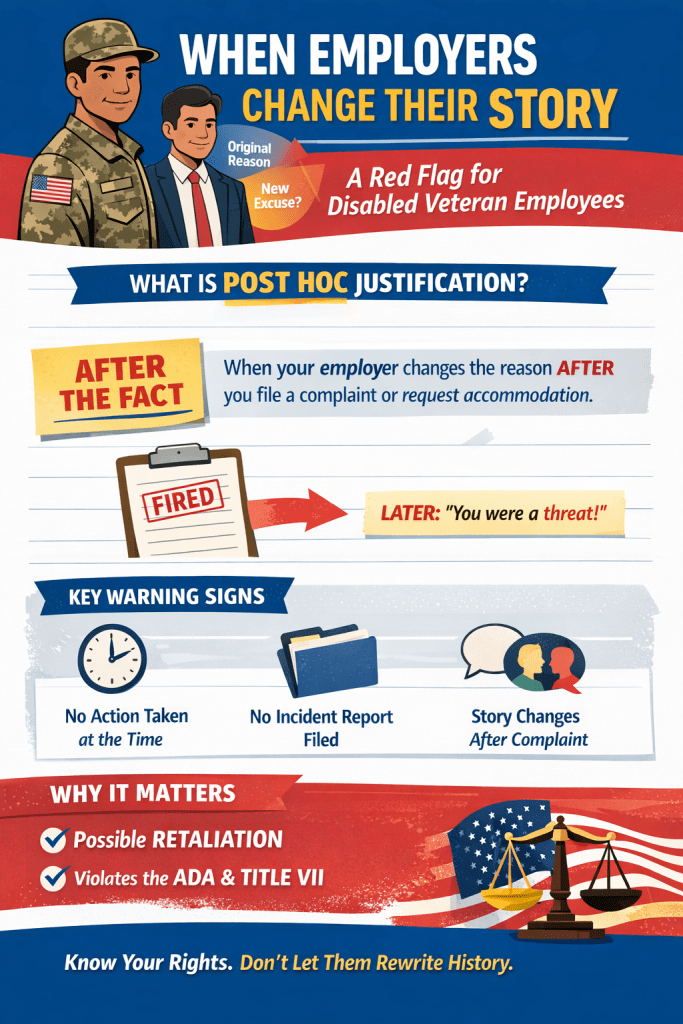
🎯 What Is Post Hoc Justification?
Post hoc justification literally means “after this, therefore because of this.”
In legal terms, it’s when an employer offers a reason for firing you after the fact, rather than at the time of the event.
So instead of saying “We fired you for X” when you were actually fired, they say it later — often after you legally challenge them or allege discrimination.
This matters because:
- It shows the employer’s stated reason wasn’t truly what motivated the decision.
- It suggests the real reason might be retaliation for something protected — like disability accommodation requests or whistleblower complaints.
This is especially important for disabled veterans, who are protected under both federal law (ADA) and local anti‑discrimination ordinances.
📌 Example: The Threat That Never Was
Imagine this scenario:
- You notify your employer you won’t work around a certain person because of a credible threat to harm you.
- You ask to be excused for your safety.
- No one investigates, makes a report, or documents anything that night.
- You continue to work, but later you’re fired.
Then, months later, your employer claims you were fired because you “threatened violence.”
If there’s no contemporaneous report, no incident documentation, no witness statements at the time, and no HR action on the day of the event — that’s a strong indicator the “threat” reason was created after you complained or asked for accommodation.
That’s post hoc justification — shifting the reason after the fact to justify an adverse decision that was likely caused by something else (like your disability disclosure or protected complaint).
🧠 Why This Matters for Disabled Veterans
If your employer:
- Returns with a new reason only after you engage in protected activity (like reporting discrimination),
- Changes its explanation over time,
- Or provides a reason contradicted by its own conduct or records,
then that’s not just a clerical mistake — it’s evidence that the stated reason is a pretext.
Pretext means the reason given is not the real reason.
And under both federal law (ADA, Title VII, ADEA) and many local laws (including Madison Ordinance § 39.03), pretext is exactly the type of evidence used to prove discrimination and retaliation
🔍 How to Spot Post Hoc Justification
Here are the key indicators:
✔ The employer didn’t mention the reason until after you complained
✔ There’s no contemporaneous documentation of the alleged conduct
✔ The employer’s policy for handling the alleged issue wasn’t followed
✔ Witness accounts don’t support the new justification
✔ You were previously evaluated as adequate or competent before the protected activity
✔ The timing of the termination closely follows your protected complaint
When these signs line up, it raises a strong inference of retaliation — not legitimate conduct.
🛡️ Why It’s Important for Your Legal Case
In discrimination law, you don’t always have to prove that the employer intended discrimination.
Instead, you show:
- You engaged in protected activity (like reporting discrimination or asking for accommodation),
- You suffered an adverse action (like termination), and
- The employer’s stated reason is weak, inconsistent, or post hoc.
If the stated reason is pretextual, the law allows investigators, hearing officers, or judges to infer discrimination or retaliation.
This is true under:
- Americans with Disabilities Act (ADA)
- Title VII of the Civil Rights Act
- Age Discrimination in Employment Act (ADEA)
- Local anti‑discrimination ordinances like Madison Ordinance § 39.03
📣 A Word for Disabled Veteran Employees
You deserve workplace safety, accommodation, and equal treatment — period.
When an employer tries to justify a disciplinary action with a reason that only came after you exercised your rights, that’s exactly the kind of evidence that supports a retaliation claim.
So if you notice:
👉 reasons that change over time
👉 lack of documentation
👉 timing that follows your complaint
trust your instincts — it’s not just coincidence. It’s legal evidence.

 Outpost 422