When Employers Change Their Story: A Guide for Disabled Veteran Employees
By Bradley J. Burt (adapted for public/legal context)
If you’re a veteran with a disability facing workplace discrimination or retaliation, you’re not alone — and understanding how employers sometimes defend their actions can be a powerful tool in your legal toolbox.
One of the most common tactics employers use to justify unlawful conduct is something called a post hoc justification. Let’s break that down in clear, everyday language and explore how it affects disabled, veteran, or otherwise protected employees.
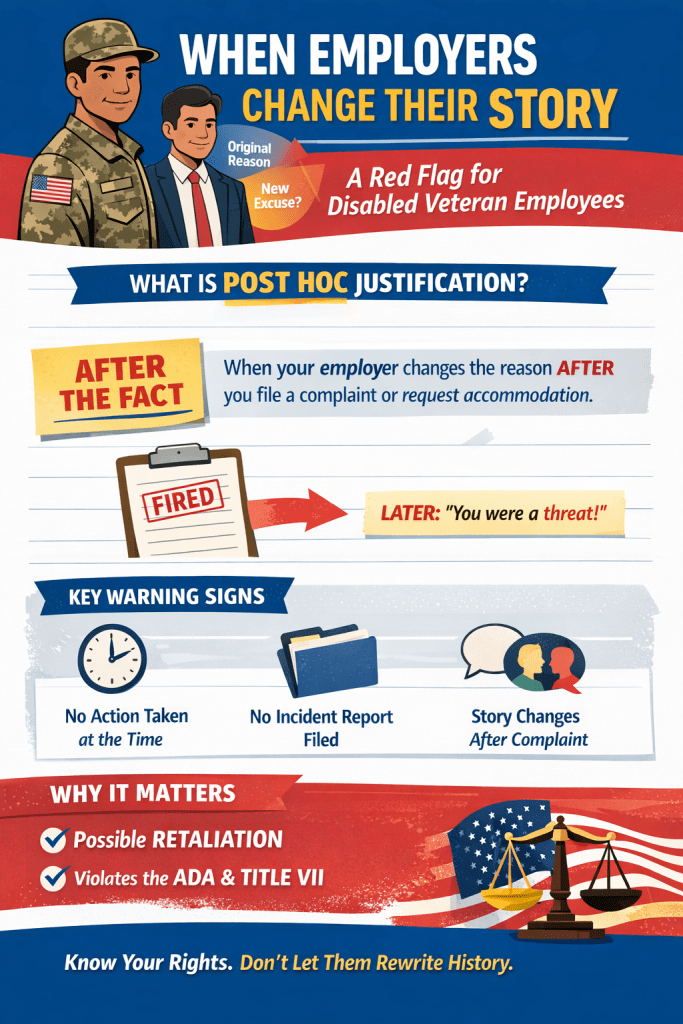
🎯 What Is Post Hoc Justification?
Post hoc justification literally means “after this, therefore because of this.” In legal terms, it’s when an employer offers a reason for firing you after the fact, rather than at the time of the event.
So instead of saying “We fired you for X” when you were actually fired, they say it later — often after you legally challenge them or allege discrimination.
This matters because:
It shows the employer’s stated reason wasn’t truly what motivated the decision.
It suggests the real reason might be retaliation for something protected — like disability accommodation requests or whistleblower complaints.
This is especially important for disabled veterans, who are protected under both federal law (ADA) and local anti‑discrimination ordinances.
📌 Example: The Threat That Never Was
Imagine this scenario:
You notify your employer you won’t work around a certain person because of a credible threat to harm you.
You ask to be excused for your safety.
No one investigates, makes a report, or documents anything that night.
You continue to work, but later you’re fired.
Then, months later, your employer claims you were fired because you “threatened violence.”
If there’s no contemporaneous report, no incident documentation, no witness statements at the time, and no HR action on the day of the event — that’s a strong indicator the “threat” reason was created after you complained or asked for accommodation.
That’s post hoc justification — shifting the reason after the fact to justify an adverse decision that was likely caused by something else (like your disability disclosure or protected complaint).
🧠 Why This Matters for Disabled Veterans
If your employer:
Returns with a new reason only after you engage in protected activity (like reporting discrimination),
Changes its explanation over time,
Or provides a reason contradicted by its own conduct or records,
then that’s not just a clerical mistake — it’s evidence that the stated reason is a pretext.
Pretext means the reason given is not the real reason.
And under both federal law (ADA, Title VII, ADEA) and many local laws (including Madison Ordinance § 39.03), pretext is exactly the type of evidence used to prove discrimination and retaliation
🔍 How to Spot Post Hoc Justification
Here are the key indicators:
✔ The employer didn’t mention the reason until after you complained ✔ There’s no contemporaneous documentation of the alleged conduct ✔ The employer’s policy for handling the alleged issue wasn’t followed ✔ Witness accounts don’t support the new justification ✔ You were previously evaluated as adequate or competent before the protected activity ✔ The timing of the termination closely follows your protected complaint
When these signs line up, it raises a strong inference of retaliation — not legitimate conduct.
🛡️ Why It’s Important for Your Legal Case
In discrimination law, you don’t always have to prove that the employer intended discrimination.
Instead, you show:
You engaged in protected activity (like reporting discrimination or asking for accommodation),
You suffered an adverse action (like termination), and
The employer’s stated reason is weak, inconsistent, or post hoc.
If the stated reason is pretextual, the law allows investigators, hearing officers, or judges to infer discrimination or retaliation.
This is true under:
Americans with Disabilities Act (ADA)
Title VII of the Civil Rights Act
Age Discrimination in Employment Act (ADEA)
Local anti‑discrimination ordinances like Madison Ordinance § 39.03
📣 A Word for Disabled Veteran Employees
You deserve workplace safety, accommodation, and equal treatment — period.
When an employer tries to justify a disciplinary action with a reason that only came after you exercised your rights, that’s exactly the kind of evidence that supports a retaliation claim.
So if you notice:
👉 reasons that change over time 👉 lack of documentation 👉 timing that follows your complaint
trust your instincts — it’s not just coincidence. It’s legal evidence.
The subject matter argument presented in this blog communication shares a real life hypothetical regarding how Corporate Machiavelli will pressure you as a disabled veteran to turn over information when a “corporate citizen” suspects you as an employee have a service-related PTSD.
Human Resources papers you through documentation, who will later use the information in Court to identify you as “combative” or “threatening” when you challenge the legality of the retrieval of VA medical record information, which happened to me.
As a client with the Wisconsin Division of Vocational Rehabilitation who entered the workforce for Marcus Corp. working at the Sun Prairie Marcus Palace Cinema and Live Nation d/b/a Frank Productions LLC at the Sylvee, the Majestic, Breese Stevens Field, High Noon Saloon and the Orpheum, both employers DID NOT follow proper VA Privacy Guide Protocol.
For my upcoming meeting with Marcus Corp.’s counsel, the Respondent’s counsel requires I turn over my secret security clearance and ALL information regarding my socials protected under discrimination argumentation by the Federal Labor Relations Act. The corporate citizen uses intimidation of an irrelevant subject matter to intimidate me into submission, which I will not do.
I am required to disclose information without my consent along with answer burdensome questions in the form of interrogatories that do not apply in this case. The Respondent’s counsel also requires I provide confidential communication by Tribolt Security LLC’s Chief Executive Officer Dave Marerro, a well-known and respected Special Forces operator. I have informed the Wisconsin Supreme Court Office of Lawyer Regulations regarding my perception of intimidation that resulted from the adherence to filling out both Respondents’ interactive dialogue process questionnaire seeking information beyond the scope of requested accommodations, which employers cannot do.
As an upstander and 10th Mountain Division QRF observer reporter in the community, I exposed the information publicly and now I must face the wrath on March 12, 2026, at my Wisconsin ERD appeal hearing facing off self-represented as a law student against Marcus.
The substantive fact in both cases comprises prima facie that the employers received multiple complaints and management did not escalate to Human Resources regarding multiple employees who threatened violence that eventually led to the termination of one who stated, “Don’t just die! Suffer!” The managers stated the dialog reported by multiple employees “did not rise to the occasion” to escalate. Yet, according to the information provided to me by Lt. Cindy Holmes of the Dane County Sheriff’s Dept., who declared most certainly did.
Note: After calling out trolling by the Majestic Venue Manager, who later quit, the company engaged in papering. The questions went outside the scope of requested accommodations. You as a disabled veteran, upon bringing forward concerns for adverse actions, will receive papering in the from of an interactive dialogue process questionnaire.
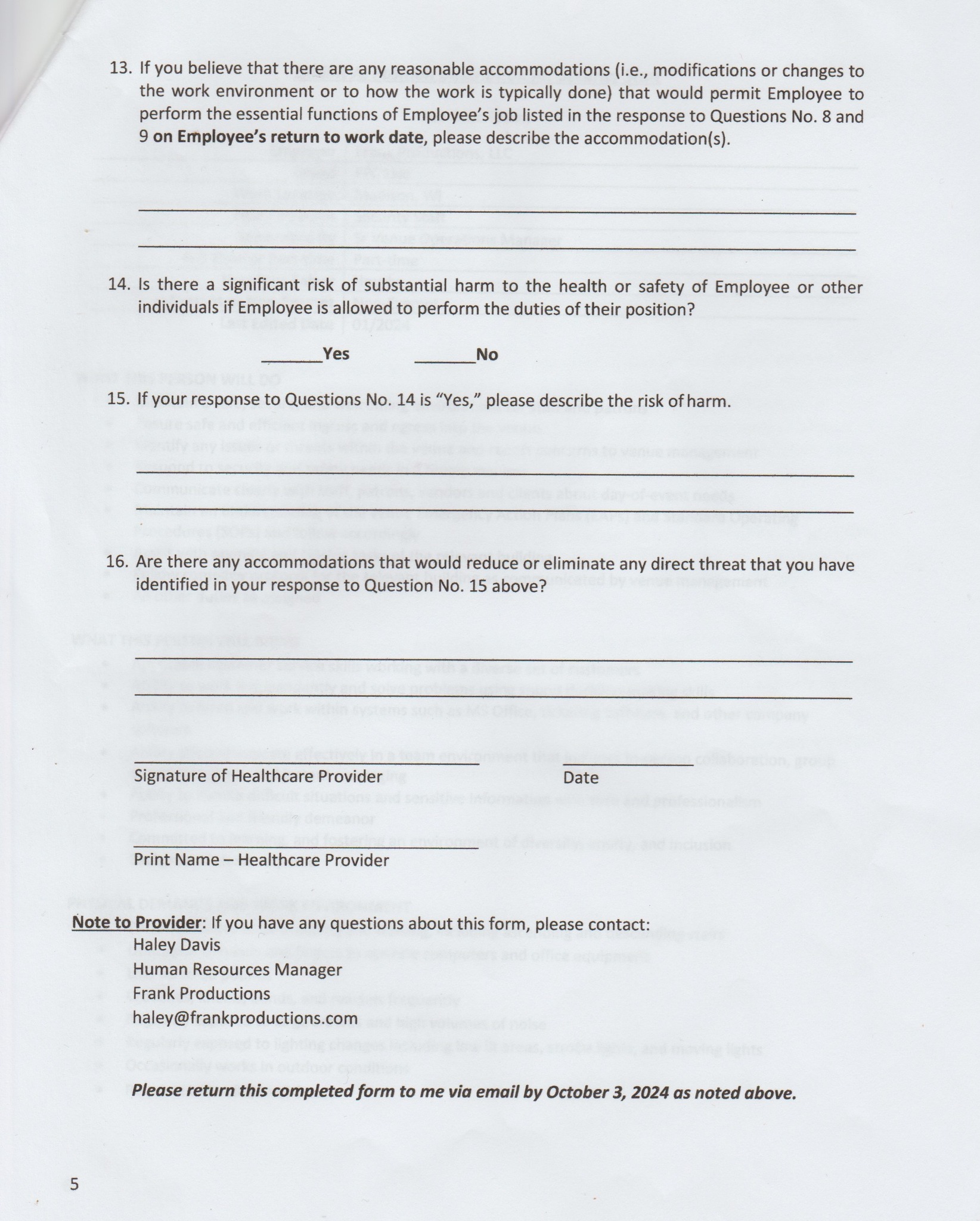
Frank Productions LLC terminated me after I declined to blindly follow the employer’s demands I fill out an interactive dialogue process questionnaire. The overreaching scope of both parties’ questionnaires exceeded the protocol of VA patient “self-reporting.” Frank Productions LLC, not being happy with the response by the VA’s primary care provider, made clear I needed to go to “real” primary care provider to clear me as a perceived threat. No civilian primary care provider can access your VA records without your permission and this royally pissed the Human Resources manager off as I reported here in previous DVR discrimination blog press release reports as outlined in my college indpendent study.
Frank Productions LLC, the author of the document currently submitted to an ERD investigator as an exhibit, models a similar attempt to legally retrieve information from the VA suspecting I was a disabled veteran with PTSD for making clear I must first speak with my VA primary care doctor, the VA Privacy Director, EEOC Senior Legal Analyst Sharron Rennert and the DVR director before sharing information that could expose what I did while serving as a Special Forces commander’s RTO in Haiti while serving on QRF.
The companies dug deep and because I resisted, I was a perceived threat for standing up for VA patient medical record privacy that I perceived as discrimination. For the sake of protecting fellow deployment vets, I shared my DVR progress report observations publicly to warn other veterans, which is my legally protected right to do here at Outpost 422.
I later self-reported through my VA primary care provider I have “LightFighter Syndrome (migraines),” which was an amendment I field with my VA record privacy to discuss publicly my time down range regarding my traumatic brain injury. I was informed I did not need to disclose any condition other than what I was requesting accommodations for yet the employers made ironclad either I fill out the forms or risk losing merit and had Frank Productions LLC CEO Joel Plant make clear would not accommodate me unless the form featured below was filled out. For this reason, I have rebranded Outpost 422 as a VA Patient Adjudicator service to inform those who are afflicted by a bad-faith employer who uses interrogatories and Human Resources demands to intimidate you into availing a PTSD diagnosis for papering purposes.
The service is registered with the VA Inspector General Office to connect you as a VA patient with information regarding how to connect with free VA pro bono legal services to help you navigate.
Concerted Activity: The Federal Labor Relations Act
You have the right to act with co-workers to address work-related issues in many ways. Examples include: talking with one or more co-workers about your wages and benefits or other working conditions, circulating a petition asking for better hours, participating in a concerted refusal to work in unsafe conditions, openly talking about your pay and benefits, and joining with co-workers to talk directly to your employer, to a government agency, or to the media about problems in your workplace. Your employer cannot discharge, discipline, or threaten you for, or coercively question you about, this “protected concerted” activity. A single employee may also engage in protected concerted activity if he or she is acting on the authority of other employees, bringing group complaints to the employer’s attention, trying to induce group action, or seeking to prepare for group action. However, you can lose protection by saying or doing something egregiously offensive or knowingly and maliciously false, or by publicly disparaging your employer’s products or services without relating your complaints to any labor controversy.
Denying an employee/former employee’s right to uphold Wis. Stats. 103.20, specifically “Hours of Operation,” I reported my concerns to the director of DVR in the form of blogs and social media posts fully protected under my civil rights under said Act. After filing an ERD complaint, retaliation for speaking publicly began by Attn. Welsh in the form of interrogatory who willingly acted above the language contained in DWD 218, while I self-represented through the Outpost 422 whistleblowing agency.
The Federal Labor Relations Act Section 1.[§151.] states, “The denial by some employers of the right of employees to organize and the refusal by some employers to accept the procedure of collective bargaining lead to strikes and other forms of industrial strife or unrest, which have the intent or the necessary effect of burdening or obstructing commerce by (a) impairing the efficiency, safety, or operation of the instrumentalities of commerce; (b) occurring in the current of commerce; (c) materially affecting, restraining, or controlling the flow of raw materials or manufactured or processed goods from or into the channels of commerce, or the prices of such materials or goods in commerce; or (d) causing diminution of employment and wages in such volume as substantially to impair or disrupt the market for goods flowing from or into the channels of commerce.”
Of course, for our veteran community protection, I filed an EEOC Whistleblower complaint against Attn. Welsh along with a grievance with the Wisconsin Supreme Court Office of Lawyer Regulation for trying to retrieve my federally protected military service information but also protected information pursuant the VA Privacy Guide. So, I woke up on Christmas Day and got to work preparing for our upcoming New Year’s Eve “concerted activity” protected conversation. Here is what ChatGPT has to say about what your employer must provide you upon your signature of an accepted employment offer:
Below is ADA-, EEOC-, and veteran-compliant onboarding language that employers commonly include in offer packets, employee handbooks, or onboarding portals. This language is neutral, avoids unlawful inquiries, and properly opens the door to accommodations without singling out VA patients, veterans, or PTSD.
You may use this verbatim or adapt it with counsel.
[Company Name] is an equal opportunity employer. We do not discriminate against applicants or employees on the basis of race, color, religion, sex, sexual orientation, gender identity or expression, national origin, age, disability, genetic information, military or veteran status, or any other status protected by applicable federal, state, or local law.
Employment decisions are based on qualifications, merit, and business needs.
2. ADA Reasonable Accommodation Notice (Critical Section)
Reasonable Accommodation
[Company Name] is committed to providing reasonable accommodations to qualified individuals with disabilities in accordance with applicable law.
If you need a reasonable accommodation to perform the essential functions of your job, or to participate in any part of the onboarding or employment process, please contact Human Resources at [HR contact information]. Requests will be handled through an interactive process and kept confidential to the extent required by law.
Why this works legally
Invites disclosure without coercion
Does not reference PTSD, mental health, or VA status
Triggers ADA duties only if the employee initiates
3. Medical Information & Confidentiality Statement
Medical Information Confidentiality
Any medical information provided to [Company Name] will be maintained in a confidential file separate from personnel records and will be disclosed only as permitted by law.
Employees are expected to perform the essential functions of their positions and to comply with all company policies and performance standards. Reasonable accommodations may be provided where required by law; however, accommodations do not eliminate essential job functions or performance expectations.
This protects the employer from later claims that standards were waived.
5. Safety & Conduct Statement (ADA-Compliant)
Workplace Conduct and Safety
[Company Name] is committed to maintaining a safe and respectful workplace. All employees are expected to follow safety rules and standards of conduct. Employment actions are based on observed conduct and performance, not on assumptions about medical conditions or personal characteristics.
This language is important if safety issues later arise.
6. Veteran & Military Status Protection (Optional but Recommended)
Military and Veteran Status
[Company Name] values the service of members of the U.S. Armed Forces and complies with the Uniformed Services Employment and Reemployment Rights Act (USERRA). Employees will not be discriminated against based on past, present, or future military service.
7. Optional Onboarding Portal Checkbox Language
☐ I understand that if I need a reasonable accommodation to perform my job or to participate in the onboarding process, I may contact Human Resources.
This creates a record without forcing disclosure.
8. Language You Should NOT Include (for Compliance)
Do not include:
Questions about PTSD, mental health, or VA treatment
“Voluntary disclosure” checkboxes about disabilities before employment begins
Language suggesting veterans or VA patients require special monitoring
Broad consent for medical records
Legal Bottom Line
This onboarding language:
Complies with the ADA and EEOC guidance
Avoids unlawful medical inquiries
Protects veterans under USERRA
Preserves employer performance and safety authority
Minimizes discrimination and retaliation risk
Stand up for your rights to expose employers who stigmatize military service PTSD. Report employers to the Better Business Bureau who profile fellow disabled veterans as threatening like Live Nation did to me on the night of Tammy Baldwin’s Election Nov. 5, 2024, which led to my termination and a ban letter for a baseless allegation of threatening violence. And most of all, the demands mutually expressed by both Marcus Corp. and Live Nation I comply with fully filling out their interactive dialogue process questionnaire, which the VA says cannot do.
Keep checking in at Outpost 422 in the upcoming months as I start to slowly leak publicly available information regarding my discrimination cases filed with the the City of Madison Equal Opportunity Commission, Wisconsin Equal Rights Divsion, and the Equal Employment Opportunity Commission who are the venues and judicial oversight of my ongoing appeals and my upcoming TDIU severance hearing in Milwaukee, Wis. regarding the unbecoming conduct that led to receiving my severance letter by the two aforementioned parties.
Outpost 422 is a VA Patient Adjudicator service. If you would like to discuss legal options available to you provided pro bono to VA patients, please fill out the contact form.
Are you a veteran stuck in bewilderment regarding reporting harassment, intimidation or the like as discrimination? Please check out the ChatGPT Legal Assistant research available to you at no cost. Also, if you are a veteran in Dane County, Wisconsin, contact your local VA social worker who can help you navigate locating pro bono services.
ChatGPT Legal Assistant Thesis Question: What is the threshold that Wisconsin Fair Employment investigators use for determining disparate or pervasive treatment? Is there a document?
1. Disparate Treatment Under Wisconsin Law
Definition (Intentional Discrimination)
Wisconsin’s Fair Employment Law makes it unlawful to treat employees or applicants less favorably in employment because of protected characteristics such as age, race, sex, disability, etc. if the adverse action is at least in part due to that protected status. Wisconsin Workforce Development
This is similar to the federal disparate treatment concept: an intentional adverse decision based on a protected class. Wikipedia
Investigator Threshold
There is no publicly-posted numeric or percentage “threshold” (e.g., “X number of instances”) that Wisconsin investigators use to decide disparate treatment. Rather, the Equal Rights Division looks at whether discriminatory intent or motivation can be inferred from the evidence — for example, whether a protected characteristic was a motivating factor in the adverse action.
In practice this is often assessed through evidence such as comparative treatment of similarly situated employees and whether the protected trait influenced the decision.
Document Source
The Wisconsin statute itself (Chapter 111, Sections 111.31–111.395) defines unlawful discrimination, but doesn’t set a numerical threshold. A widely disseminated Wisconsin Fair Employment Law poster summarizes what is unlawful but does not quantify thresholds. Wisconsin Workforce Development
🧠 2. Harassment / “Severe or Pervasive” Conduct in Wisconsin
State Law Standard
For harassment (hostile work environment) under Wisconsin law, the conduct must be:
Because of a protected characteristic, and
More than a few isolated incidents or casual comments, involving a pattern of abusive, degrading conduct that interferes with work or creates an offensive/hostile environment. Wisconsin Workforce Development
This standard echoes “severe or pervasive” definitions used in federal law (e.g., Title VII) but under Wisconsin law is framed around pattern and workplace interference — again without a numeric cutoff.
📄 3. Official Guidance or Investigator Manuals
State Guidance
Equal Rights Division User Guides exist for procedural and case-management matters, but not policy thresholds for substantive legal standards. Wisconsin Workforce Development
Wisconsin DWD/ERD does not publish an investigator manual setting a precise numeric threshold for disparate treatment or harassment.
The ERD Civil Rights webpages outline what constitutes discrimination and harassment but do not specify an exact “tests” or cut-off counts. Wisconsin Workforce Development
Secondary/Internal Documents
Some informational documents (e.g., Fair Employment Law Basics or Equal Rights Decision Digest) summarize decisions and elements from past cases, which can be useful for research but are not policy manuals issued to investigators for threshold determinations. LIRC Wisconsin
📌 4. Analogous Federal EEOC Guidance (Useful for Context)
While not Wisconsin law, federal Equal Employment Opportunity Commission (EEOC) guidance on disparate and pervasive treatment — such as in hostile work environment claims — is often used as a reference in training or investigations:
However, again, no specific numeric threshold is prescribed — assessments are fact-intensive and context-driven. EEOC
“Severe or pervasive” harassment standards are explained in EEOC guidance (e.g., hostile environment harassment must be sufficiently severe or pervasive to alter terms/conditions of employment). EEOC
🧾 Summary
Issue
Wisconsin Standard
Threshold / Document
Disparate Treatment
Intentional unfavorable treatment because of a protected class
No official numeric threshold; assessed factually
Harassment / Pervasive
Pattern of abusive conduct tied to protected status interfering with work
No automatic numerical cut-off; fact pattern evaluated
Policy / Manual
ERD provides process info and law summaries
No public “investigator threshold” manual found
📌 Where to Find More Detailed Official Materials
Here are links you may review for statutory language and official explanations:
The blog is a legal reference that does not constitute “giving legal advice,” rather is an informative tool to help veterans understand their rights protected under Wis. Stats. 111.32. Please contact the Wisconsin State Bar if you are seeking information regarding how to obtain counsel. The VA will help you overcome worry and fear and face the obstacle of advocating for military service fair employment.
If you have a tip, lead or need please contact the Outpost 422 evidence intake agency at Bob Cobb on Facebook. Bob is the Capitol Wolfwatch customer service connect who will walk with you each step anonymously.
I, Bradley J. Burt, named patient, request a hearing outlined in the instructions from the letter from the Oct. 31, 2025, letter I received from the Dept. of Veterans Affairs regarding severing my individual unemployability. The issue of gainful employment only reported exceeding the National Poverty Line threshold and not substantive facts in this case, which I have provided as an overview of retributive attempts by employers who challenged VA protocol with their interactive dialogue process questionnaire, I have been informing the VA of since 2021.
The problematic onboarding intimidation and harassment I receive stems from papering me for having suspected war-related PTSD. I was diagnosed with Traumatic Brain Injury and requested TBI accommodations. Now, as a result, my disability increased resulting from Human Resources demands I provide secondary conditions I will not provide due to protecting my role with National Security information shared with VA social workers regarding working with Special Forces as an M-60 RTO in Haiti. I absolutely refuse to breach my secret security clearance thus creating hazing by Human Resources.
The VA stated the VA cannot get involved in employment matters leaving me prey to attacks I have received up to and including meeting with Lake Effect Strategic HR & Law Human Resources Advisor Jennifer Lindberg who indicated my dialog regarding TBI attacks and requests for accommodations by her client, Live Nation d/b/a Frank Productions LLC, believed my discussion warranted concerns for coworker safety who profiled me, then terminated me for a perception of an active threat. I have provided in my URL link portfolio exhibits that will expand in detail at my hearing if the VA should choose to proceed who lacks the grounds to do so.
I am submitting this statement to document my concern regarding disparate treatment I have experienced as a disabled veteran employed by Frank Productions LLC.
As an individual who has served in the military, I have encountered a workplace environment that I believe does not provide a welcoming or inclusive space for veterans. I have observed behaviors and policies that appear to reflect bias against my background and beliefs as a veteran. These experiences have led me to feel marginalized and unwelcome.
I have reported this matter to the Department of Veterans Affairs Office of Inspector General (VA OIG), expressing concern that the systemic oppression of disabled veterans in certain workplaces remains unaddressed. I have described this pattern of behavior under the term “LightFighter Syndrome®”, referring to the ongoing discrimination and exclusion of disabled veterans within civilian employment settings.
It is my sincere hope that my complaint will be reviewed and addressed as a matter of concern, in accordance with the VA’s patient privacy and protection guidelines. Veterans deserve to work in environments that respect their service, dignity, and right to fair treatment without bias or retaliation.
I have acted above and beyond the call by notifying the public through my WordPress self-reporting VA Patient Adjudicator outlet, Outpost 422, which examines the variables of college and employment readjustment and reintegration of combat veterans being a combat veteran who successfully graduated Summa Cum Laude as a Madison College VITAL patient. Severing my unemployability only makes matters worse.
Now, I cannot obtain gainful employment and have substantive proof of such claims I shall bring before the VA. What I seek in exchange is a letter sent to previous employers by the Secretary of the VA. The problem in Madison, Wis., we patients face is Communism and a governor who violates our rights by flying the colors improperly.
We are under duress at Madison College who hosts the VA’s VITAL program and request an audit and possible removal of the program and transfer to UW Milwaukee where patients are served best. Madison College is a domestic terrorism safe harbor and have left my role as the Student Senate vice president of legislative affairs after receiving the report our vice president of public relations identified as such. I received an email attack by the Madison College Student Senate advisor and vice president of administration and finance while taking my law final. I identified the issue as hazing and usurping, then tenured my resignation.
I respectfully request that the VA consider whether a hearing is necessary at this stage, given that my employment records with Live Nation reflect ongoing complications related to my prior report and subsequent termination. The letter contains statements I believe are inaccurate, and I intend to provide documentation to clarify these points. Former employers’ automated reporting systems appear to have mischaracterized my actions, resulting in significant reputational and employment harm.
Currently, I have over a dozen discrimination complaints pending against multiple parties and until the subject matter from all of my cases adjourn with a ruling, I am no longer gainfully employable and noted with the Social Security Administration that my date of termination, Nov. 8, 2024, was the date I was no longer able to obtain gainful employment, which was the day Live Nation d/b/a Frank Productions LLC terminated me for alleged threatening violence and remain on FPC’s ban list wrongfully.
Disabled veterans in the Dane County area cannot compete with landlords who require a “three-times” rent agreement also known as “gentrification.” When totally and permanently veterans listed as “individually unemployable” seek work opportunities, those who view military service as racist, predominantly those who preach critical race theory in management and human resources, run the veteran off the job.
The problem disabled veterans face is the inability to keep up with gentrification who become HUD-VASH statistics. What can be done?
Why should a disabled veteran who could afford their apartment who no longer be required to live amongst crack dealers, those who try to rewrite philosophy with “violent protest”, or worse yet graffiti the Wisconsin Veterans Museum?
Dane County, mainly in Madison, has an anti-veteran problem. I propose a voucher system that allows the disabled veteran a cap and a requirement of 20 percent HUD-VASH tenancy who then will open opportunities for homeless veterans who also qualify for more opportunities other than waitlists.
Or better yet, establish a recruiting model that transitions disabled veterans through remote proctored instruction, which will qualify the individual with a noncredit option, then utilize the research for receiving HUD-VASH grants that could potentially provide the landlord or academic institution with economic stimulus. I suggest renovating the downtown Madison College campus into a HUD-VASH readjustment and rehabilitation transition center allowing potential candidates access to Madison College classes on-site.
The operation could raise $2.5 million for renovation capital, then accept tenants on a first-come educational eligibility opportunity to sell and provide data regarding the needs of those afflicted. Once a pilot fully matures the building’s depreciation, then the pilot can renovate unused buildings for harnessing creativity with those who manage trauma-informed symptoms like LightFIghter Syndrome®.
By focusing on the needs of disabled veterans who are individually unemployable, a corporate vendor could potentially study, through focus groups, why disabled veterans struggle in society and how to implement welcoming environments, which could potentially stimulate the veteran hiring sector, provide administrative short-term jobs and track outcomes with tenant qualitative analysis.
By focusing on the housing needs of those who suffered injuries in service, the workplace can grow into a place where lost time and shift coverage could easily be filled on a last-minute basis as a part of a rent-free living experience.
By having unemployable veteran work for rent voucher as a rent offset, the Dane County rental community could potentially resolve the ongoing issue with veteran homelessness by reconnecting individuals with their learning minds first in a noncredit capacity, then grow into a creative intelligence mindset performing small tasks and duties that usually comprise $18-$20 per hour.
By divesting in vouchers, a business could own an apartment complex, decrease staff, gain access to block grants and run a lean operation with disabled veteran independent interns who at least receive at the minimum pride in workmanship. The solution is simple. Hire individually unemployable veteran quid pro quo for rent and then watch the workplace thrive in their absence.
No veteran is hopeless and could have an opportunity to take a troublemaker angry at the world and convert them into becoming employable again.
Critiquing the science of the Korean War at the Wisconsin Veterans Museum Bradley Burt, Clarion business director
For the “Critiquing Science on Display Assignment,” I visited the Korean War display at the Wisconsin Veterans Museum seeking the scientific bits from an anthropological perspective of war and military service. The critique perspective critically examined accuracy and the dialogical connect regarding the modeling of exhibit arrangements with artifacts and displays.
Overview of critiqued materials on the basis of class instruction material
Exhibits are forms of visual publication. The critical appraisal of the Korean War exhibit analyzed the collaboration of branches of service and overall impression as an exhibit, which prepared notes according critique writing handouts from this week’s online class. The experience was rewarding and have a new appreciation when visiting monuments and war exhibits as a blogger and journalism etiquette columnist. Etiquette is hardly a word to describe the Korean War from an anthropological perspective. “Brutal” and “barbaric” are the terms that come to mind when analyzing war. For the project, the subjective mindset was left in my backpack. Visitors must leave backpacks behind at the front desk prior to entrance to the museum.
War is flux: The science of colonization Over the course of several years attending both Madison College and the University of Wisconsin-Whitewater, I began meeting with the curator of the Wisconsin Veterans Museum in 2019 for the Practicum 2 course.
Writing about historically significant items brings pleasure and joy. Using the ethnographic survey approach, I learned in sociology, helped me remove prejudice and report according to the checklist we were provided in class this week. The exhibits on display at the Wisconsin Veterans Museum share one thing in common: each is a relic from history. From a critical analysis, a display must be written either as Chicago, Associated Press or American Psychological Association styles.
From a historically accurate perspective, each writing style represents either a social science, a timestamp or a reflection. The Korean War exhibit has an anthropological survey style offering onlookers narratives, timelines and historically accurate information. The museum, from an overview vantage point, took the visitor through history over the course of American war history eras.
Social science critical view analysis Archaeology and anthropology work in unison. The archaeologist collects the artifacts, and the anthropologist registers them. The overview is the anthropological survey. I learned, in the Anthropology: Myth, Magic and Religion course, the survey starts when an anthropologist marks the surveyed area with rope, tape and flags until the anthropologist decides the survey is done.
Museums use anthropologists writeups for displaying items, which use APA style. Collaboratively, when sifting through the ashes of war, forensic analysis is required for identifying charred remains and badly blown-up items, which is a forensic pathologist’s job. There are many vantage points that collaborate amongst many forms of science. The Wisconsin Veterans Museum critique examined the writing styles, the relics, items retrieved and returned from the combat zone and the evolution of weaponry that the museum displays.
Anthropologist Harvey Whitehouse and Philosopher Dr. John Rawls are the two social scientists who’ve made a lasting impression on America with ethical approaches to war correspondence publication, whom are the professionals I use for analyzing rhetoric and dialogue. For military dress inspection, I use my Cornell West Point note taking style for comparing exhibit notes.
Through the eyes of both interactive investigative journalist and 10th Mountain Division artillery dress inspection training, the evaluation of military displays took into consideration the textual communication the curator used. On a side note, in my opinion, I would hope a veteran museum would take military protocol into consideration and did not see the writeups written the same.
The goal for the exhibit critique sought writing a collaboration between reader and writer regarding the value of displaying war material ethically. Unless the reader served in the military, the understanding of what goes on in the military cannot be taken into consideration as museums cater to all. Scratch that off the list for now.
In cinema, oftentimes military uniforms are out of order only because Hollywood is required to do so. Exhibits are not cinema. When visiting Washington, D.C. and witness narrated videos instead of screen-printed write ups like witnessed at the Wisconsin Veterans Museum, I get irritated because narrated videos are subjective on the bias of the storyteller telling the visitor what they believe is most important. Kudos to the curator for not taking this approach.
The views shared ethnographically survey exhibits and their value as relics of war historically narrating the process of colonization starting from the macro view of the Korean War invasion, which narrated a micro view of the specific event, then examined write ups and narratives on the premise of the outcome of the Korean War police action from a scientific approach to the comparison and analysis of reporting styles.
The art of war: The Korean War crucible as an exhibit Whitehouse examines COVID in contrast to war. Whitehouse believes conflict narrates the crucible of society through “identity fusion,” which he discusses regarding the Taliban’s winning in Afghanistan found on his press page. From an overview examination of war, an exhibit shares how the crucible of resolving conflict sculpts and shapes nations. The exhibit critique examines relics and critically analyzes the construction of the exhibit on a macro-view basis.
The Wisconsin Veterans Museum specializes exclusively in military history. From a historical vantage point, displays provided mannequins, glass cases, relics, write ups, platforms and staging, along with screen printed back drops sharing the crucible and perspective of war. The level of cleanliness, from a combat and field veteran’s point of view, was amazing. Relics from war are typically worn out or badly damaged. The Wisconsin Veterans Museum did a superb job cleaning and displaying items for all to view. The Korean War began in the ‘50s, which would mean the items on display have aged for over 70 years.
Using typography and publication as an art exhibit Rawls’ believes “the Doctrine of Double Effect” instructs publishers to consider a tolerance with viewers and provide the viewer with the right to decide the good or bad end. If the publisher decides to write subjectively then do so with the caveat the end must not devalue the mean. War is the mean. The curator provided mostly tangible items and photographs rather than narration. Rawls’ insists the viewer, for publication ethics, receive the “Veil of Ignorance” respect.
Very simply stated, the exhibit critique determines whether or not the curator narrated items objectively with a third-person narrative or subjectively with first-person. The curator built the Korean War exhibit formally and with a professional appearance. The write ups were built in Chicago style and did not witness any grammatical flaws. The micro-view critique, which took up close and personal considerations based on Rawls’ instructions, critically analyzed items by seeking details regarding the items presented without opinion. Only fact and how the words contrast what the exhibit displays.
The exhibit’s brevity Items examined and critiqued considered information from the “Exhibit Writing Tips” handout. The curator’s use of brevity was the focus of critiquing. The critique of each exhibit in chronological order as listed in the handout starting with “Credit Lines” and concluding with “Talkback Text.” Aside from views, the writeups and narratives provide contrast and details as a scientific communication exchange with visitors. Brevity is the art of narration, which is an Oxford term for being brief. The viewer should walk away feeling informed and not persuaded. The curator did a great job.
Brevity meets the minimum requirement of succinctness, and the write ups felt engaging, which delivered informative details. The research provided by the curator’s oversight shared mindful and helpful information from the vantage point of Rawls’ ethical inspection of published materials. The material on display allows photographers to take pictures without flash, which is made clear upon entering the gallery. Photography use is a form of publication and must not alter items photographed. Viewers will think critically because the curator’s writeups are objectively telling the story of the Korean War from quotes and anecdotes along with conservative typography.
The “Structuring Exhibit Text” Critique The micro-view examined all 12 points regarding instructions for structuring text for exhibits from the handout students received as a part of instruction. The handout was used for notetaking and laid aside all prejudice with personal experiences from deployment as a veteran. The writing was difficult to read from afar and had to get up close for reading purposes.
• Titles and headlines: The use of caps does not conform to Associated Press style. • Intro to text: Italics were not necessarily a writing style only used as an eye catcher. • Primary or section text: Commas were appropriately used. • Secondary text or subtext: Paragraphed details made for reading difficulty. • Sidebars: None • Object labels: Exhibit did not make clear what items were. • Image captions: The photography narrative was appropriate and concise. • Quotes: Quoted field commander and his opinion. Use of ellipses felt clunky. Quotes were not written in Associated Press style and appeared abstract. • Credit lines: Gen. Douglas MacArthur was not attributed properly in Associated Press style. • Talkback labels: Made anecdotal references regarding what took place during the war. • Wayfinding signage: Was not apparent or obvious to the viewer. • Additional text: Signage did not follow a specific style. Had a hard time making out what signage said from afar, which could cause longer than normal exhibit loitering times.
From the viewer’s vantage point, the exhibit felt alive and detailed historical events well. From a journalist viewpoint, the writeups appeared as amateur or novice. The exhibit artifacts and photographs captured history well but the empty space in “The See-Saw War” writeup had dead space where another picture should have gone or even a map of the terrain would have been helpful. The artifacts felt engaging, and the arrangement of items was positioned professionally for the viewer to connect with other displayed items. Overall, the captions were appropriate lengths and liked the monochrome photographs taken from the war.
The Wisconsin Veterans Museum could use photo slideshows, who noted upon entry, “we have only eight percent of our items displayed from our vault.” Well, that’s great and all but with the invention of interactive media, a photo slideshow could help tell the story with flow codes and cross dissolved Ken Burns Effect storytelling styles through television screens that would allow for a broader display of artifacts through the use of Adobe software. A follow-up interview with the curator has been scheduled and are welcome to listen to exhibit critiques.
The future of interactive storytelling: Convergent media collaboration with the curator The Korean War display did not mention the role of the Wisconsin Air National Guard, which played a pivoting role with the outcome of the war. After conducting research in college, I later learned the Wisconsin Air National Guard leads the Air Force in strategic decision making for bomber squadrons and will be meeting with the curator to discuss building stories around the interactive storytelling model. Convergent media isn’t just for the news and the press. Museums can take full advantage of the style too.
The upcoming final paper analyzes the work of the University of Wisconsin Missing-in-action Recovery and Identification Project. The museum offered to sit down and discuss a possible photo slideshow regarding the Wisconsin Air National Guard and the last flight of 1st Lt. Jerome A. Volk, whose family is friends with the project’s director. Legislatively, the project has the opportunity to locate three Wisconsin MIAs if the State of Wisconsin approves upcoming bill, Senate Bill 8, which would allocate $360,000 to the University of Wisconsin-Madison Biotechnology Center and help locate Volk as one of the missing pilots. The curator likes the idea of building a legislative exhibit and will be volunteering at the museum in service to the POW MIA families of Wisconsin who do not have an exhibit. The next visit seeks collaborating with the curator to include MIAs with war exhibits.



 Outpost 422