
Outpost 422 Investigates Workplace Documentation, Disability Accommodations, and the Future of Evidence-Based Journalism
MADISON, Wis. — Nearly two years after his termination from Frank Productions following a November 5, 2024 assignment at the Orpheum Theatre during U.S. Senator Tammy Baldwin’s election-night event, U.S. Army veteran Bradley J. Burt says his focus has evolved from a single employment dispute into a broader examination of workplace documentation, disability accommodations, and the role artificial intelligence may play in future administrative proceedings.
Rather than treating the matter solely as litigation, Burt has spent the past two years assembling what he describes as a “Journalism eDiscovery” archive—a chronological collection of emails, text messages, agency correspondence, hearing records, unemployment decisions, veterans’ documentation, and contemporaneous notes intended to preserve an objective documentary record.
“I realized this wasn’t just about one termination,” Burt said. “It became a question of how evidence is preserved, evaluated, and presented when disability accommodations, veterans’ rights, and workplace investigations intersect.”
Letter to the Vice President
Vice President Vance,
I am writing as a disabled U.S. Army veteran, journalism graduate, and legal studies student seeking your attention to an issue I believe extends beyond my individual employment case.
On November 5, 2024, while assigned to work security at the Orpheum Theater in Madison during U.S. Senator Tammy Baldwin’s election-night event, I contend I was terminated shortly afterward following months of advocating for disability accommodations, workplace safety, and veteran-related concerns. I believe the documentary record raises important questions regarding the treatment of disabled veterans in the workplace, the interactive accommodation process, and whether stereotypes surrounding PTSD can influence employment decisions.
Prior to my termination, I documented concerns through emails, text messages, and internal communications. I raised workplace safety issues, advocated for veteran suicide awareness initiatives, requested accommodations through the interactive process, and attempted to comply with my employer’s requests while also following guidance from my Department of Veterans Affairs medical providers. My VA physician advised that portions of the employer’s medical questionnaire exceeded the scope of what my primary care provider could appropriately certify.
After my discharge, I received a ban letter and allegations that I have consistently disputed. Subsequent administrative proceedings have produced a substantial documentary record, including unemployment findings that concluded my discharge was not for misconduct or substantial fault and noted that the employer failed to provide evidence sufficient to establish misconduct during that proceeding.
Rather than simply pursuing litigation, I transformed my experience into a research initiative called Journalism eDiscovery. The project explores how artificial intelligence, investigative journalism, documentary evidence, and legal analysis can work together to preserve factual records, organize evidence chronologically, and improve transparency in administrative proceedings.
My concern is that disabled veterans should never have to choose between requesting reasonable accommodations and protecting their careers. Equally important, allegations involving PTSD or military service should be evaluated through objective evidence rather than assumptions or stigma. Veterans deserve fair investigations, due process, and employment decisions grounded in documented facts.
I respectfully invite you and your staff to review my work at www.outpost422.com. My purpose is not to request intervention in my pending matters, but to demonstrate how emerging AI-assisted documentation and investigative journalism may help strengthen transparency, accountability, and confidence in workplace investigations and administrative justice for veterans and all Americans.
Thank you for your consideration and for your continued support of those who have served our nation.
Respectfully,
Bradley J. Burt
U.S. Army Veteran
Founder, Outpost 422
Journalism eDiscovery Research Initiative
www.outpost422.com
A Timeline Built on Documents
According to Burt, the documentary record begins months before his separation from Frank Productions.
The timeline includes requests for disability accommodations, communications regarding an Interactive Process Questionnaire, workplace safety discussions, text messages with coworkers, unemployment proceedings, Equal Rights Division filings, and ongoing appeals.
Among the documents Burt highlights are:
- Communications regarding disability accommodation requests.
- Correspondence with Department of Veterans Affairs medical providers concerning employer medical documentation.
- Text messages documenting relationships with coworkers before the termination.
- Workplace safety concerns raised during employment.
- Wisconsin Unemployment Insurance findings concluding the discharge was not for misconduct or substantial fault, while noting the employer did not provide evidence during that proceeding sufficient to establish misconduct.
- Administrative filings now forming part of a growing documentary archive.
Burt argues these records should be viewed chronologically rather than as isolated events.
From Employment Case to Research Project
Instead of allowing the documents to remain scattered across multiple proceedings, Burt developed Journalism eDiscovery, an emerging framework combining investigative journalism, legal analysis, documentary evidence, and artificial intelligence.
The project seeks to answer a broader question:
Can AI help organize evidence without replacing human judgment?
The concept focuses on preserving contemporaneous records, authenticating timelines, identifying factual inconsistencies, and improving transparency before administrative hearings or court proceedings.
Rather than asking artificial intelligence to determine who is right, the framework emphasizes helping readers understand what was documented, when it was documented, and how those records evolved over time.
A Veteran’s Perspective
Burt, a former member of the U.S. Army’s 10th Mountain Division, says his military experience continues to shape his approach to documentation and accountability.
He contends that disabled veterans often face unique challenges when navigating accommodation requests while attempting to remain productive employees.
One area of continuing interest involves the relationship between workplace investigations, disability accommodation procedures, and public perceptions surrounding post-traumatic stress.
Burt maintains that employment decisions affecting veterans should be evaluated through documented evidence rather than assumptions or stereotypes.
Those issues remain the subject of pending administrative proceedings.
Looking Ahead
Outpost 422 will continue publishing documents, timelines, and investigative analyses as additional records become available.
Future installments will examine:
- the chronology leading to the November 2024 termination;
- disability accommodation documentation and interactive process communications;
- unemployment findings and subsequent administrative proceedings;
- witness chronology and credibility analysis;
- and the continuing development of the Journalism eDiscovery framework.
The project also seeks to explore how AI-assisted document organization may improve transparency for journalists, self-represented litigants, veterans, researchers, and public agencies.
Whether the documentary record ultimately supports or contradicts Burt’s claims will remain a matter for the appropriate tribunals. Outpost 422’s objective is to preserve the chronology, present the available evidence in context, and encourage readers to evaluate the record for themselves.
About Outpost 422
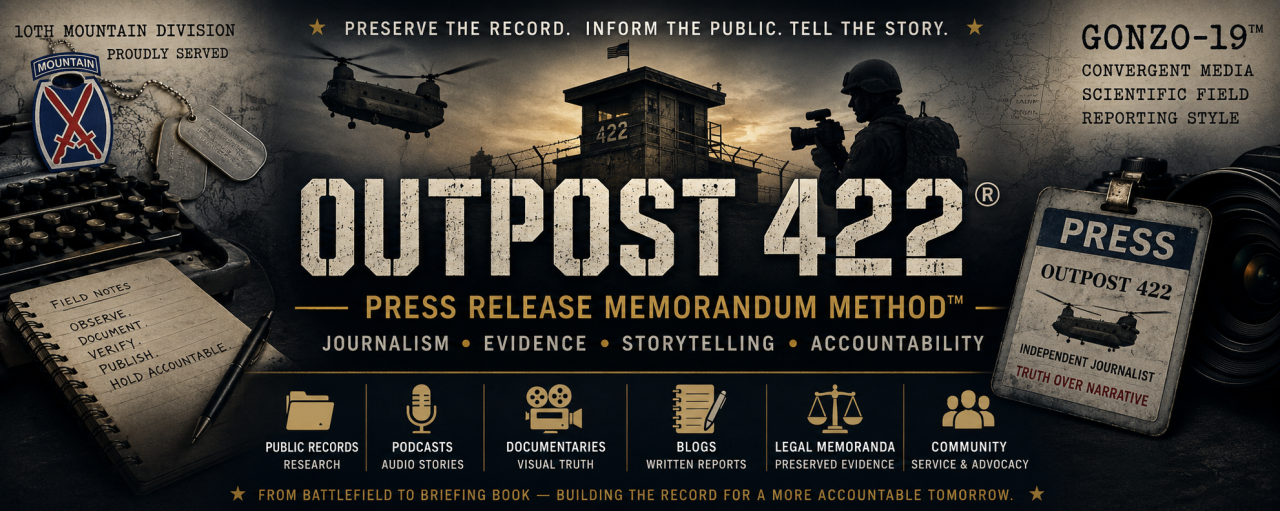
Outpost 422 is an independent multimedia journalism initiative founded by U.S. Army veteran Bradley J. Burt. Through investigative reporting, documentary storytelling, and the Journalism eDiscovery framework, the publication examines veterans’ issues, administrative law, workplace accountability, public records, and the responsible use of artificial intelligence in investigative journalism.